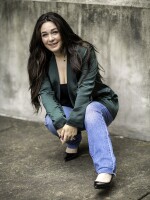
For decades, the stories of Route 66 have been dominated by the voices of well-travelled men. But to Route 66 historian and travel writer Cheryl Eicher Jett, women were the true heartbeat of the Mother Road.
Her new book, “Aprons Away: Women’s Work on Route 66,” tells the stories of 80 women -- from motel matrons and diner waitresses, to architects, artists, and journalists -- some known and others overlooked.
“They were so – um – scattered,” said Eicher Jett of the stories she discovered. “And that’s when I thought these should be collected so they don’t disappear, eventually.”
To Jett, these women broke the mold and should be remembered.
Cheryl Eicher Jett spoke with KWGS’ Angel Ford about her research and her book. The following is a transcript of that interview, lightly edited for concision and clarity.
Angel Ford:
You obviously love history. You've written- this is your eighth book and it's like, I don't even know how many, about Route 66, right? Was there any kind of unconventional source or rumor or artifact that you came across that became one of your most valuable tool to kind of piece these stories together?
Cheryl Eicher Jett:
Well, you know, I was very lucky in running into the daughters of some of these women. I mean not literally running in to, of course. I had to do a little searching, but I did find the daughters of two specific women that told wonderful stories about their mother(s).
One was a woman named Francis May, who was the daughter of Ruby Angel Denton. Ruby was a restaurant operator in Groom, Texas. Very feisty, very determined woman, but you know, the heart of gold type. She operated a restaurant there for a long time, initially to support her family and then because she loved doing it. But her daughter told many stories, and her daughter must have been a chip off the old block because when she told the stories, it was just like her mother telling them.
And then I located the daughter of a highway engineer, Marilyn Reece, in California. She was the first licensed female highway engineer for California Division of Highways, which of course became Caltrans. So those interviews were priceless. Then I found interviews that other people had done of various women, and those were exceptionally helpful.
AF:
I was really excited to hear that there are still descendants of these women around and speaking and talking and highlighting their ancestors in this way. So that's really cool to hear. And that they were able - you were able to find them. Sometimes these people are hard to track down.
CEJ:
Yes, they are. And it was a lot of luck and good fortune to find them also because a number of the women that I profile in the book were very independent women and they went into male dominated fields. And sort of a part of that package is that they did not marry and have children. So, there were no descendants in many cases.
AF:
Oh, wow. Okay. Can you tell me a little bit about how many women did you highlight in your book and were there any that you had to edit out?
CEJ:
Approximately 80 women, uh, are included in the book. And I actually, near the time of publishing, I actually dropped two chapters out simply because the book was getting so big and unmanageable. And they were chapters that were a little more difficult to write and to conclude. One of those that I will mention is a chapter that was called ‘Collections.’ And these were women that had either saved things, historical items, into a collection themselves, or they had inherited and were safeguarding a husband or parent collections. And all of those collections ended up being the spark that started one or a different one museum. And in one case, it was an Oklahoma attraction.
AF:
I love to call those people family archivists, because I have many people in my family who are like that. They call themselves hoarders. I call them family archivists, because they're the ones that keep the stories alive, you know?
CEJ:
Exactly. You're kind and correct. Yes. So, if there's ever a volume two of this book, the story of these women who, prized and safeguarded the collections, that will certainly be a chapter in the next volume.
AF:
That sounds incredibly interesting, and I would love to be reading that one because I love collectors. I've always thought of people who collect as people who want to hold on to memories and history and keep those things alive when so many people forget, you know. So, it's a really cool thing. Are there any stories that you came across that kind of have stuck with you, a specific woman or women?
CEJ:
The woman that I mentioned, Ruby Denton, with the restaurant in Groom, Texas, her stories really stuck with me. She had a humble beginning, you know, just very modest home, modest family. She encountered all sorts of difficulties in acquiring her restaurant because the bank wouldn't loan money to a divorced woman. Friends and family helped her, and she just had a lot of grit and determination. She was also funny and feisty. and she really well represents what I think of is the sort of visible women. And that was the women that served the traveling public along Route 66. So, if you went home and you had a memory from Route 66 at a restaurant or a diner, someone served you, but those were the women that were truly visible. to the Route 66 traveler, where a lot of women were more behind the scenes. And as a historian and as a woman, I knew there were more women that were working behind the scenes that weren't known to the traveling public. And of course, that encompassed journalists and designers and engineers and sometimes business owners that just weren't so visible.
AF:
Yeah. On that same note, in your research, what is kind of the most stubborn myth about these women's lives that you've kind of actively had to fight against or look into?
CEJ:
There's a couple stories regarding that situation. One is women who were architects and designers, I'm thinking particularly Mary Coulter, who was a designer with the Fred Harvey Company. She designed a lot of the buildings at the Grand Canyon and in Arizona and New Mexico, a little bit in California. And back then in the early 1900s, women who, and they were very few that worked in architectural offices. There was one, for instance, in Frank Lloyd, a woman in Frank Lloyd Wright's office too. And the question has always lingered. how much of the architectural work these women actually did, because their names weren't necessarily included on the plans. So there has been a little bit of back and forth on that with the one camp that Mary Coulter didn't. She was certainly acknowledged as a designer. But there's a camp that says, No, she didn't really do the architectural work. So, I would say, the architectural women. That was an issue. And then the Fred Harvey company tried to dispel the myth that women who were waitresses were all of low character. And so, Fred Harvey said about kind of repairing the moral character that was thought of as a waitress.
AF:
Makes sense. And kind of to bring a modern parallel to our history to now. Can you, I mean, looking back at some of the systemic barriers that these women faced, what is one invisible labor that women are still against today that you predict society will kind of recognize 50 years from now?
CEJ:
I think it's many of the career choices that have been systemically thought of as male dominated for such a long, long time. And of course, women are right breaking barriers in virtually all of those fields now. But I'm sure that some of them suffer along the way. Some type of discrimination, just like back in the early to middle 1900s. Women faced sexual discrimination, many of them racial discrimination. And so, the ones that really rose to the top in their fields were few and far between, and of course, much to be lauded for what they accomplished.
AF:
Yeah. And I just thought of this one. I can't believe I didn't think to write it down, but how many women or are there any women in Oklahoma in your book?
CEJ:
There are quite a few women in Oklahoma. There-- one that I really like the story of is Clara Luper, who was an activist. She was a Black woman. She was an activist for civil rights in Oklahoma City in the 1960s. And she was really a pioneer in the form of activism known as the sit-in when she-- led a bunch of her students. She was an educator and a much-honored educator for many years. And she led a group of her students at the famous sit-in at the Katz Drugstore in downtown Oklahoma City, where there's actually a memorial there now. A memorial includes one empty seat at the counter. So, you can-- the visitor to the memorial can go sit down and join them at the counter.
AF:
I loved that memorial when they announced it or they showed it. Were you able to see it and visit it already?
CEJ:
No, and I'm going on this trip.
AF:
Oh, good. I'm glad. It was such a cool thing to see them unveil, and I think a lot of people really loved it. I hope you enjoy it in person. I'm sure you will.
CEJ:
Yes, I will. I would love to have been there at the opening.
AF:
Last question to you. Why are these stories something that should be compiled and shared for the world to experience?
CEJ:
Well, I was working heavily as a travel writer and also book author, and I started running onto some of these women's stories. Some of them were pretty well known to the average Route 66 enthusiasts, but they were so scattered. And that's when I thought these should be collected so they don't disappear eventually. And I thought a book or a museum exhibit. But since I'm a writer, I thought, well, I guess it will be a book. And then when I started uncovering more of the behind-the-scenes stories, again, there were a few of those women, saying Mary Coulter, Julia Morgan, the artist Georgia O'Keeffe, were famous in their own circles, but not so much associated with Route 66. So, my inspiration was that these stories needed to be collected in one place so that the women would be remembered.